
Products
Represent what you're building: description, links, uploaded documents, and notes that AI studies can draw on.
A product entry represents something you're building. It gives AI features grounding beyond a single prototype — what the product does and who it's for — and acts as a shared home for the materials your team keeps re-attaching to studies.
What a product holds
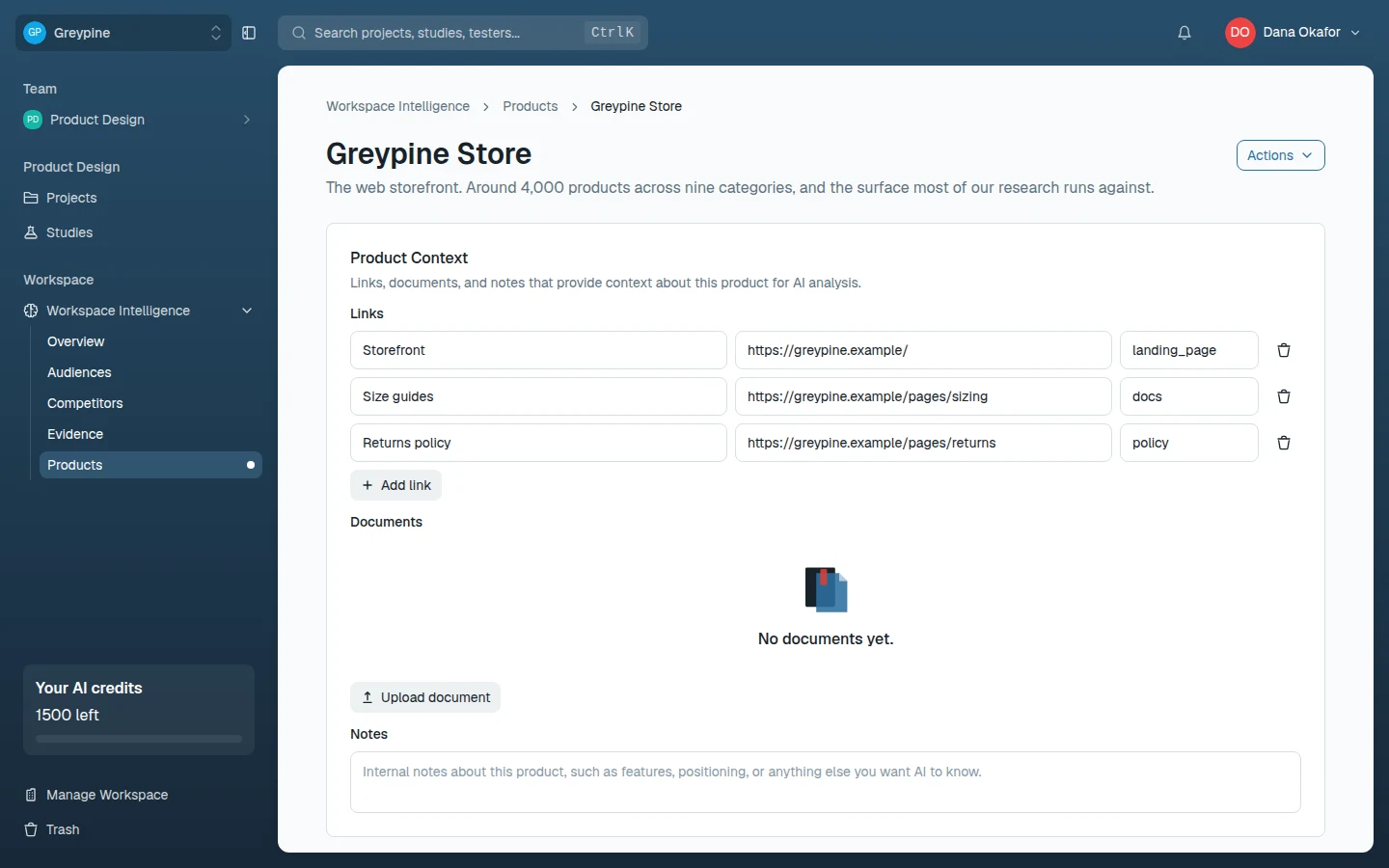
- Name and description (both required) — what it is, in plain language. The description is serialized into AI context, so write it for a reader who has never seen the product.
- Links — titled, typed pointers to where the product lives: landing page, product page, documentation, pricing, changelog, and so on.
- Documents — uploaded files (specs, one-pagers, feature briefs). When an AI study runs with Use project context, the documents of products attached to the project are sent along with it.
- Notes — internal notes about features, positioning, or anything else worth keeping with the product.
How products are used
- Attached to projects as context — an AI study with Use project context enabled sees the product's description and documents.
- Linked from evidence — an evidence item names the products it's about, and AI context carries that link along with the finding.
Products vs. projects
A project organizes research work; a product describes the thing being researched. Several projects usually point at one product — keep the durable description on the product and let projects stay disposable.
Related docs
- Workspace Intelligence and audiences
Give the AI features durable context about your product, competitors, target audiences, and research evidence.
- Screens and Figma import
Get screens into an AI study: image uploads, Figma frame import, website captures, and reuse from another AI study.
- Competitors
Track the alternatives your users compare you against, with typed research sources the AI can cite.